AI, By Design
A Decision Fabric, Not an LLM Wrapper
Five layers of intelligence - designed in, not bolted on.
The hard problems in freight can’t be solved at the surface
01
How do you optimize a 10,000-node freight network into round trips that stay HOS-compliant?
02
How do you keep hundreds of thousands of trucks running at under 10% empty miles?
Both come down to one thing
Intelligence designed into the architecture, not added on top.
See it working on a single load
One shipment.
Here’s what the system does with it.
PROBLEM STATEMENT
20 pallets of auto parts.
Minimise cost & empty miles

The load enters the system
However it arrives — EDI, API, spreadsheet, PDF — it's read, structured, and normalized on the way in. No manual entry.

Matched to capacity already in motion
The network is already planning round trips across live demand and available trucks. As pickup nears, the load is matched to a truck whose route it fits — so the return leg doesn't run empty
If nothing fits, a human steps in — once
When no fleet truck fits and pickup is close, the load surfaces as an exception. The system advises what a market truck should cost on that lane, that day. A person makes the call.
Once it's moving, the system watches it
Conditions on the route are weighed and the ETA adjusts. Tracking, status, and event logging run in the background; exceptions surface as they happen.
You can talk to the load
Anyone can ask where it is, what changed, or what's next — in plain language, at any point in its life.
Documents handle themselves
LRs, BOLs, and PODs are captured and digitized as they arrive, ready for a quick review.
One load, planned and run end to end.
The team touched it once — on the single decision that needed a human.
Assess the load. See the risk. Act in time.
Most AI is an interface sitting on top of existing software. It makes the system more accessible but not necessarily more intelligent.
But the intelligence is what creates real value.
SemiCab built five layers to make AI work intelligently.
Here is what each one does.
Layer 1
Data foundation
Loads enter from any channel - EDI, API, spreadsheet, PDF - read, created, and normalized automatically. The foundation everything runs on.
Layer 2
Mathematical optimization
Plans demand and capacity as one network, building the round trips that keep trucks full both ways.
Layer 3
Computer vision
Reads documents and images, turning paperwork into usable data.
Layer 4
Domain intelligence
Freight-specific logic that adds judgment to each decision - pricing, risk, capacity, planning, operations, documents. Not one general model guessing across all of them.
Layer 5
The interface
Plain-language requests are interpreted, routed to the right data, answered, and returned in language anyone can read. The chatbot is the doorway - not the engine.

Six kinds of intelligence. Each focused on one part of the decision.
Not one general model guessing across domains.
Freight-specific logic, grounded in your data, behind every recommendation.
Prices a market truck for any lane and day from live seasonality, traffic, and fuel indices, and publishes a freight-cost index that tracks where the market's headed.
Scores lane, vendor, and operational risk while a load is in transit and recommends action.
Scores lane, vendor, and operational risk while a load is in transit and recommends action.
Handles monitoring, ETA, and escalation through the chatbot, with live dashboards that surface exceptions as they happen and proactive alerts you can subscribe to.
Extracts and digitizes data from BOLs, PODs, and rate confirmations as they’re uploaded, ready for a quick review.
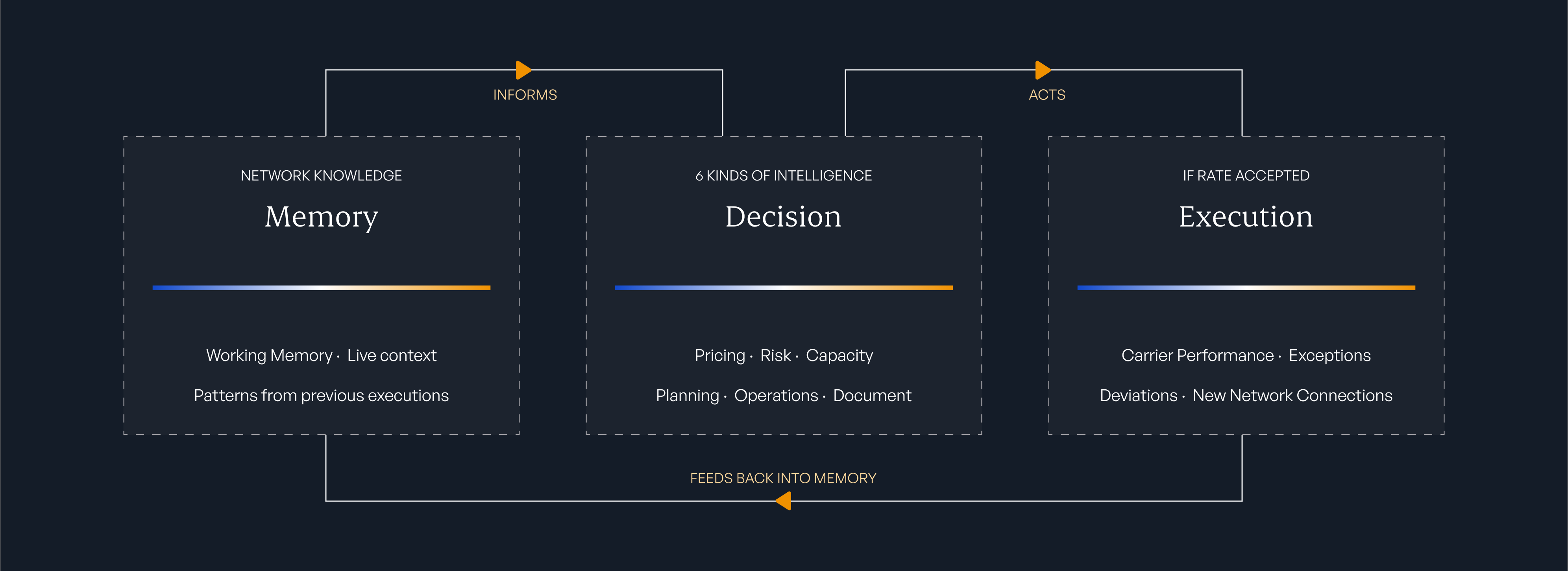
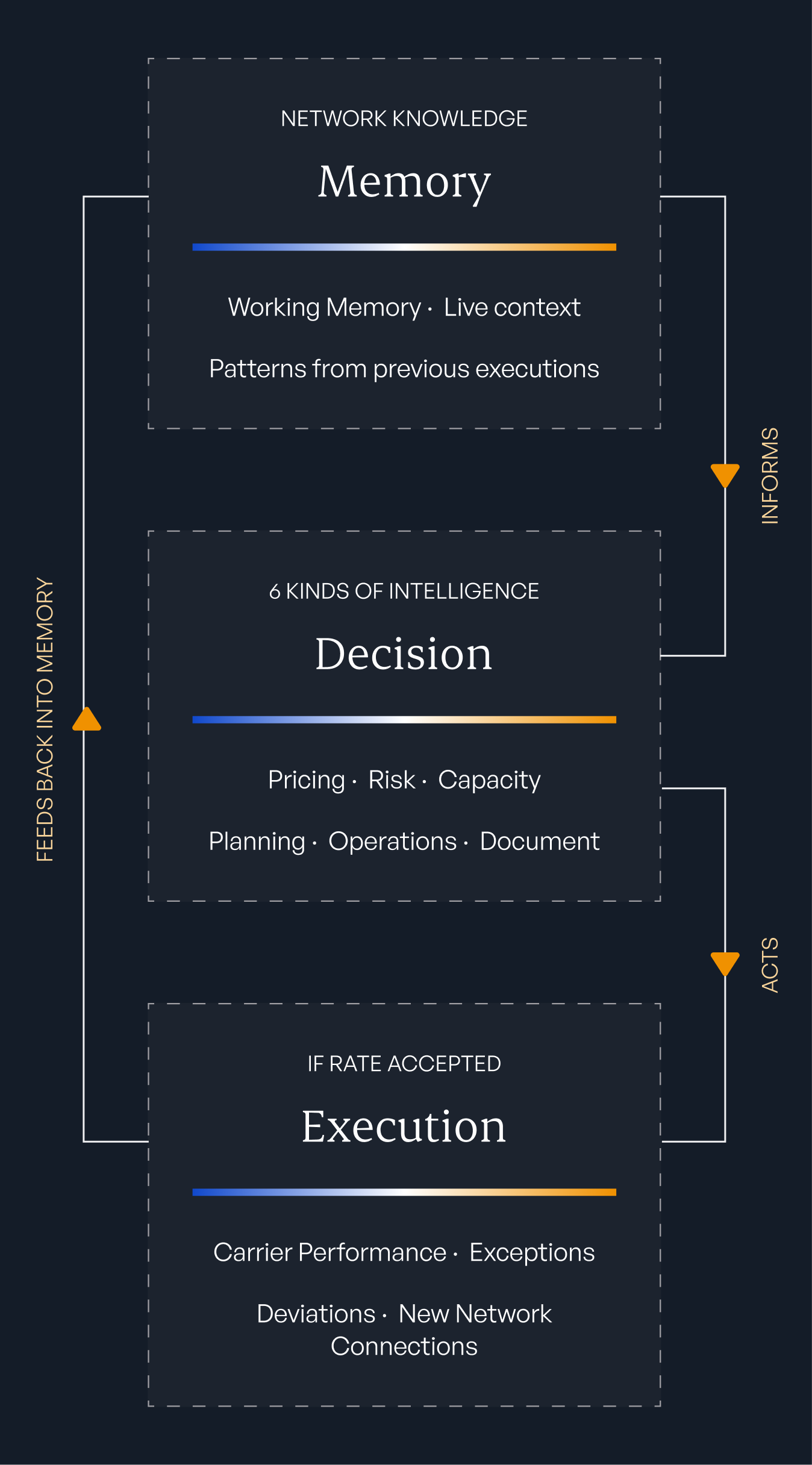
Intelligence, built to compound with every shipment
Every execution creates new signals. The system carries that learning forward, enriching the intelligence behind every decision that follows.
Measured on live networks
When the architecture is right, the outcomes are measurable.
Outcomes measured across networks running on SemiCab technology in India.
70%+
Reduction in empty miles
7%
Reduction in FTL spend
~40%
Improvement in asset productivity
5%
Spot-load reliance (reduction from ~15%)
Ready? See what this looks like on your network.
Whether you’re a shipper, an LSP, or a carrier — the conversation starts here.